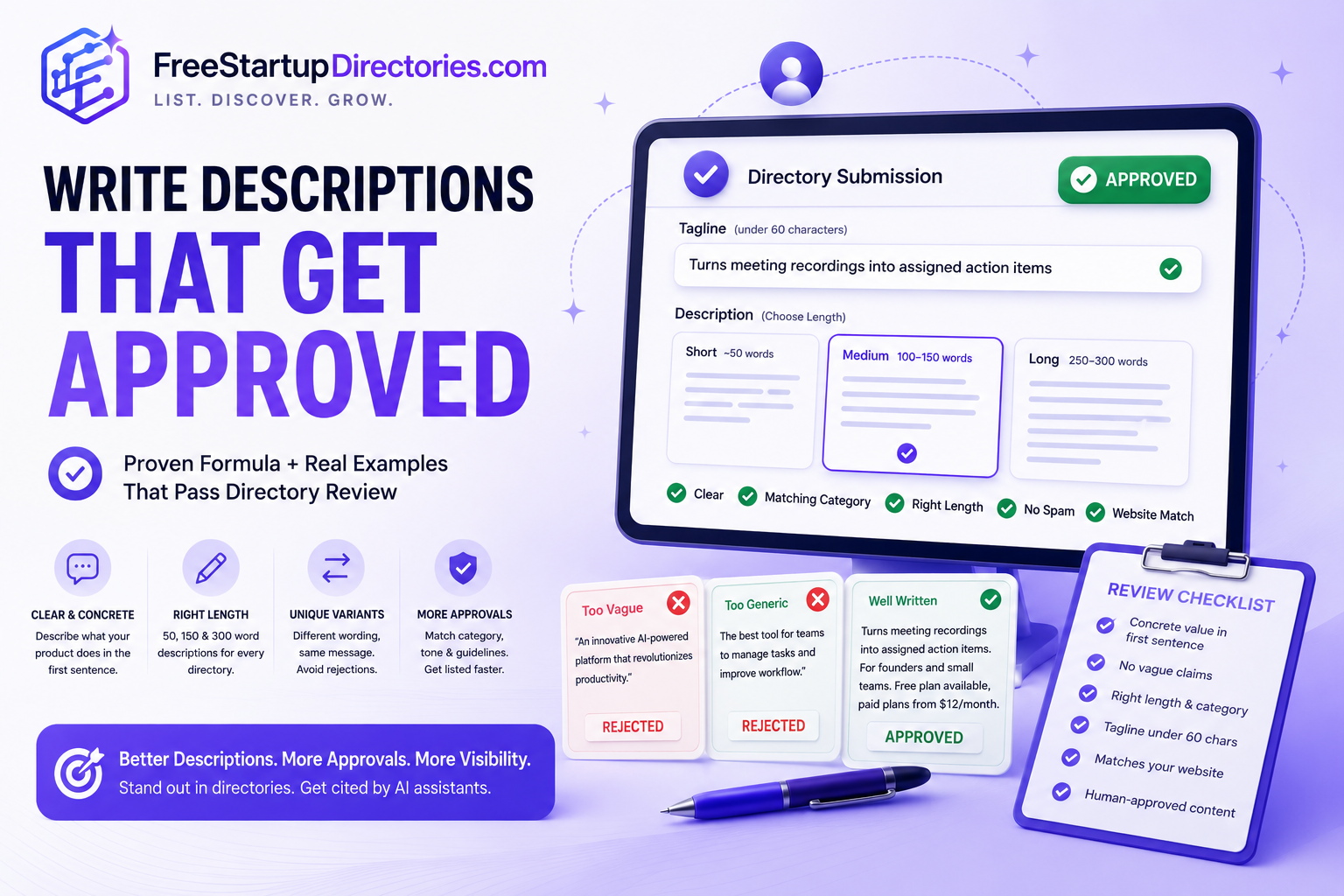
A directory description gets approved when it does three things: states concretely what the product does in the first sentence, matches the length and category the directory actually asks for, and reads like it was written for that listing rather than pasted from a press release. Most rejections trace back to violating one of those three.
This guide gives you the exact format — tagline, three lengths, and variants — plus real before/after examples of what passes review and what doesn't.
Why do reviewers reject descriptions?
Because a human reads them. On any directory worth listing on, an editor opens your submission, reads your text, clicks your link, and decides in under a minute. In that minute, vague marketing language is the most common kill. "An innovative AI-powered platform that revolutionizes productivity" tells the reviewer nothing — which product category is it? Who is it for? What does it actually do? When the description forces the reviewer to figure that out themselves, rejection is the low-effort answer.
The second most common kill is mismatch: a description that doesn't fit the field length, doesn't match the category chosen, or describes a different positioning than the website shows. Reviewers treat mismatch as carelessness, and carelessness as a proxy for spam.
The tagline: one sentence, under 60 characters
Nearly every directory asks for a short tagline, and it's the highest-leverage line you'll write — it appears in category grids, search results, and, increasingly, in AI answers when an assistant lifts your one-liner directly.
The formula: [what it does] + [for whom / from what input], in plain verbs.
Compare:
- ❌ "Supercharge your team's productivity with AI" — could be any of 5,000 products.
- ✅ "Turns meeting recordings into assigned action items" — one product, instantly understood.
- ❌ "The future of content creation is here" — says nothing.
- ✅ "Drafts SEO articles from a keyword list" — says everything.
Write ten candidates, keep the one a stranger could repeat accurately after one read. That repeatability test matters more than cleverness: your tagline is what other people — and language models — will use to describe you.
The three lengths: 50, 150, and 300 words
Directories cap description fields at wildly different lengths. Prepare three versions once, and you'll never mangle your pitch inside a character counter again:
- Short (~50 words): Your tagline expanded by one sentence of "how" and one of "who for." No feature lists, no adjectives doing heavy lifting.
- Medium (~100–150 words): The workhorse — most directories land here. Structure: what it does (1–2 sentences), how it works or what's distinctive (2–3 sentences), who it's for and pricing model (1–2 sentences).
- Long (~250–300 words): Everything in the medium version, plus your two or three headline features as plain sentences — not bullet spam — and one honest line about what makes it different. Resist the urge to fill space with superlatives; reviewers have read "cutting-edge" ten thousand times.
All three versions open with the same first sentence. That sentence is your canonical entity description — the one line that stays identical everywhere your brand appears, because consistency across the web is how search engines and AI assistants build confidence about what your product actually is. We covered why that matters in our guide to getting cited by ChatGPT and Perplexity.
Variants: same entity, different words
Here's the part most founders miss entirely. If you paste one identical description into a hundred directories, you've published the same paragraph a hundred times across the web. Directories discount it, search engines treat it as duplicate content, and the listings blur into noise.
The fix is two or three genuine variants of each length — same opening sentence, same facts, different structure and wording after that. Rotate them across your submissions:
- Variant A (workflow-led): "TaskNova turns meeting recordings into assigned action items. Upload or connect your calendar, and every call ends with a task list — owners, deadlines, and context — pushed straight into your project tool…"
- Variant B (audience-led): "TaskNova turns meeting recordings into assigned action items. Built for founders and small teams who leave calls with decisions but no follow-through, it removes the note-taking step entirely…"
- Variant C (problem-led): "TaskNova turns meeting recordings into assigned action items. Most meeting notes die in a doc nobody reopens; TaskNova skips the doc and delivers the tasks themselves…"
Same entity, zero duplication. This is exactly how we write client descriptions inside our submission packages — on Pro we prepare two variants, on Advanced three — because it measurably reduces rejections across a 200–300 directory campaign.
Matching the directory: category, tone, and scope
A perfect description still gets rejected in the wrong context. Three checks before every submission:
- Category: Pick the directory's closest real category, not the one you wish existed. If they have "AI Writing" and "Marketing," an AI copywriting tool goes in AI Writing — forcing it into Marketing because it's broader reads as gaming the system.
- Tone: Community directories (indie, maker-focused) reward a founder voice — first person is fine. Corporate directories want third person. Skim two or three live listings on the target directory and match the room.
- Scope: Your description must match what the reviewer sees when they click your link. If your site's hero says "meeting assistant" and your description says "project management platform," you've created doubt, and doubt gets rejected. Description follows website, always.
The rejection checklist
Before submitting, run every description through this list — it catches nearly everything reviewers reject:
- The first sentence names the product and what it does, concretely.
- No unverifiable claims ("the #1 AI tool", "trusted by thousands") unless you can prove them on your site.
- No keyword stuffing — "AI SEO tool AI content AI writer" reads as spam to humans and machines alike.
- No competitor names in the description (many directories prohibit it).
- Length fits the field without truncation.
- Category matches.
- Tagline under 60 characters.
- And the description matches what your website actually shows.
What this looks like at scale
Writing one good description set takes an hour of honest work. The payoff spreads across every listing you'll ever create: fewer rejections, a consistent entity footprint that search engines and AI assistants can trust, and taglines clean enough that other sites quote them verbatim.
If you'd rather not do it at all: description writing and optimization is built into our submission service — we write the variants, match every category by hand, and submit to 30+ up to 300+ directories with a report of every live link. Start by listing your tool free on our directory, explore our free database of 300+ directories, and check our step-by-step directory submission guide.